The EU AI Act and its consequences for digital corporate communications
With the entry into force of the European Artificial Intelligence Regulation, the EU AI Act, binding rules for the use of AI technologies have been defined across Europe. While much of the discussion focuses on high-risk systems in medicine or critical infrastructure, the regulation also reaches deep into the everyday work of marketing departments and editorial teams. Companies using generative language models to create copy for their website or corporate blog face new legal and quality requirements.
Using artificial intelligence noticeably speeds up text production, but it carries significant risks: a lack of factual accuracy, unresolved copyright issues regarding training data and legally mandated transparency obligations call for clearly defined processes. For businesses in Cologne and across Germany, this means one thing: unverified AI output on your blog can lead not only to reputational damage and lost search engine rankings, but potentially also to legal sanctions. At WEBETWEEN, we handle structured quality assurance for you and ensure that your content meets the standards of the EU AI Act.
Transparency and labelling: What does the law require?
A core pillar of the EU AI Act is the principle of transparency. In many scenarios, users must be able to recognise whether a piece of content was generated entirely or substantially by a machine. For blogs and editorial web content, this raises specific requirements:
Transparency obligations for AI interaction and content: Where text is generated automatically without substantial human editorial oversight, labelling rules apply to prevent deception.
Documentation of creation processes: Companies must be able to demonstrate clearly which tools were used and how the final version came about.
Copyright compliance: The EU AI Act obliges providers of generative models to be transparent about the copyrighted training data they use. Companies using these tools bear responsibility for the texts published on their own domain.
So that you can focus on your core tasks and strategic decisions, we embed these verification steps directly into our editorial and technical workflows within our blog administration.
Typical risks without a standardised review protocol
Many companies experiment with language models without establishing a documented verification process. In practice, this leads to recurring vulnerabilities:
1. Hallucinations and factual errors
Generative models produce syntactically flawless, convincing-sounding paragraphs that can nevertheless be factually incorrect. Misattributed quotes, invented court rulings or imprecise technical terms cause lasting damage to your target audience's trust.
2. Search engine devaluation and loss of relevance
Search engines evaluate content based on criteria such as Experience, Expertise, Authoritativeness and Trustworthiness (E-E-A-T). Generic, purely AI-generated copy lacking genuine expertise drops in the search results. With a targeted SEO check, we identify such shortcomings early on.
3. Brand inconsistency and legal grey areas
Without human oversight, tone of voice quickly drifts away from your defined brand values. There is also the risk of adopting protected third-party wording unchecked, which can trigger cease-and-desist warnings under competition or copyright law.
The WEBETWEEN review protocol for AI-assisted blog content
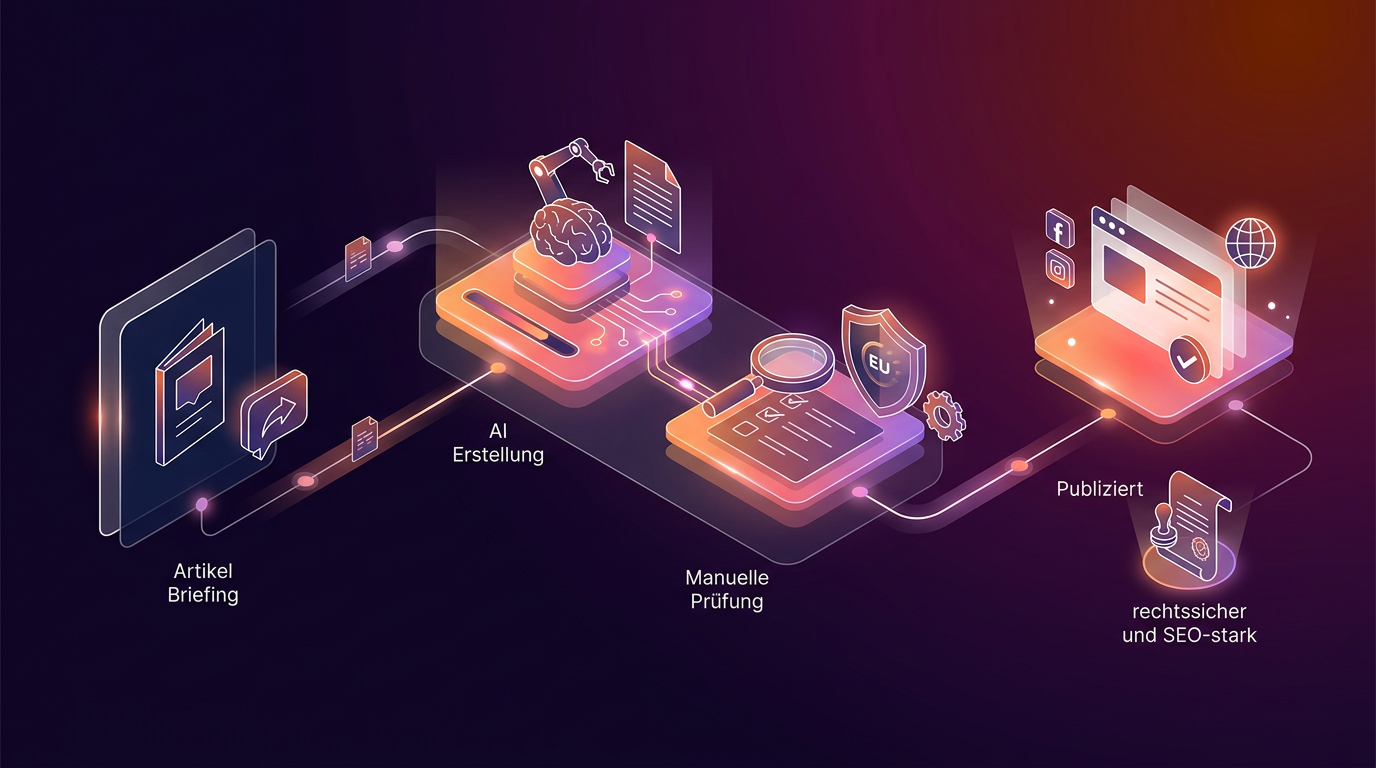
To eliminate risks and make the most of modern workflows, WEBETWEEN uses a multi-stage review protocol. Within our blog administration, we provide a review process that covers both technical and editorial checks and saves a complete audit log.
Stage 1: Prompt architecture and initial content check
Right from the drafting stage, we guide AI systems using precise, domain-specific prompts. In the first review step, we cross-check all claims, standards and data points against reliable sources. Vague or unsubstantiated statements are either verified or removed by our editors.
Stage 2: Copyright and plagiarism check
We subject the generated sections to automated plagiarism tests and compare wording against already indexed content. This ensures that no copyright-sensitive text fragments are adopted and duplicate content is avoided.
Stage 3: Editorial refinement and value-add check
A legally compliant article under the EU AI Act gains real strength through a layer of human expertise. We enrich the copy with specific industry context, optimise its structure for readability and clarity, and ensure the language fits your company profile seamlessly.
Stage 4: Technical labelling and metadata structure
Where labelling is required under the EU AI Act or editorial standards, we implement it seamlessly into the frontend as well as your website's structured data (Schema.org). This ensures transparency is mapped cleanly and in line with standards for both readers and crawlers.
Integration into your website infrastructure
Implementing a review protocol like this requires a flexible content management system and clear role assignments. During a website relaunch or when enhancing existing web systems, we design approval pipelines so that you, as the decision-maker, only need to carry out the final sign-off. We manage all intermediate steps for you on a turnkey basis – from research and prompt management through to the final legal and technical review.
For businesses looking to map complex digital workflows, we also draw on our expertise as a Lovable agency to integrate bespoke web applications that support internal review processes automatically. You can also find deeper insights into current digital developments in our Knowledge and Best Practices section.
Conclusion and next steps
The EU AI Act marks the end of an unregulated phase of automated text production. Companies that implement binding review protocols now will secure a trust advantage with their clients and avoid legal risks. We support you throughout the entire process: from defining editorial guidelines to technical integration on your platform. You can book a consultation directly with our Cologne team via our contact form.
Frequently asked questions
Does the EU AI Act also apply to standard blog posts on corporate websites?
Yes, the EU AI Act includes general transparency obligations for AI-generated content. If content is produced largely without final human editing, or if there is a risk of misleading the user, disclosure and documentation obligations apply.
Does every AI-assisted text have to be labelled as such?
That depends on the degree of human editing. If AI is only used as a research aid or to create initial outlines, and the final text is substantially written by specialist editors, many strict labelling requirements do not apply. At WEBETWEEN, our review protocol ensures your content always meets current transparency criteria.
What are the risks of breaching the EU AI Act requirements?
The legal framework provides for substantial fines, graded according to the severity of the infringement. Alongside regulatory penalties, companies primarily face cease-and-desist warnings from competitors as well as noticeable losses in search engine visibility due to poor quality.
What tasks does WEBETWEEN handle when creating blog content?
Within the blog administration system, you can carry out the final fact and plagiarism checks, edit the copy and ensure legally compliant integration into your content management system. You receive finished drafts ready for final sign-off.