For a long time, WordPress was the obvious choice for a corporate website. The system was freely available, content could be edited in-house, and there was a plugin for almost every additional task.
Yet the possibilities of website development have fundamentally changed. With AI-powered development platforms like Lovable, custom websites and features can be built directly. This undermines a key argument in favour of WordPress: more affordable delivery through ready-made extensions.
To us, it is like the difference between a horse-drawn carriage and a car. The carriage still works. But if you are buying a new vehicle today, you base your decision on what is possible today.
The same applies to a new corporate website. Our answer today is very different from what it was as recently as 2025.
1. WordPress solved a problem of its time brilliantly
WordPress emerged in 2003 from the blogging software b2/cafelog. It made publishing content easier and opened the door to additional functionality through its plugin architecture.
That was a major step forward. Businesses could manage text and images themselves. Themes provided design templates, while plugins added forms, event calendars and countless other features.
Bespoke coding was expensive. Setting up an existing plugin was often far cheaper.
A vast ecosystem grew around it: agencies specialised in WordPress, hosting providers created tailored packages, and developers produced an endless stream of new extensions. Anyone who needed a website could quickly find a supplier.
WordPress became the standard because it met a wide range of requirements cost-effectively.
Today, we can build those requirements directly. And that changes the maths entirely.
2. The patchwork of tech has to be maintained after launch
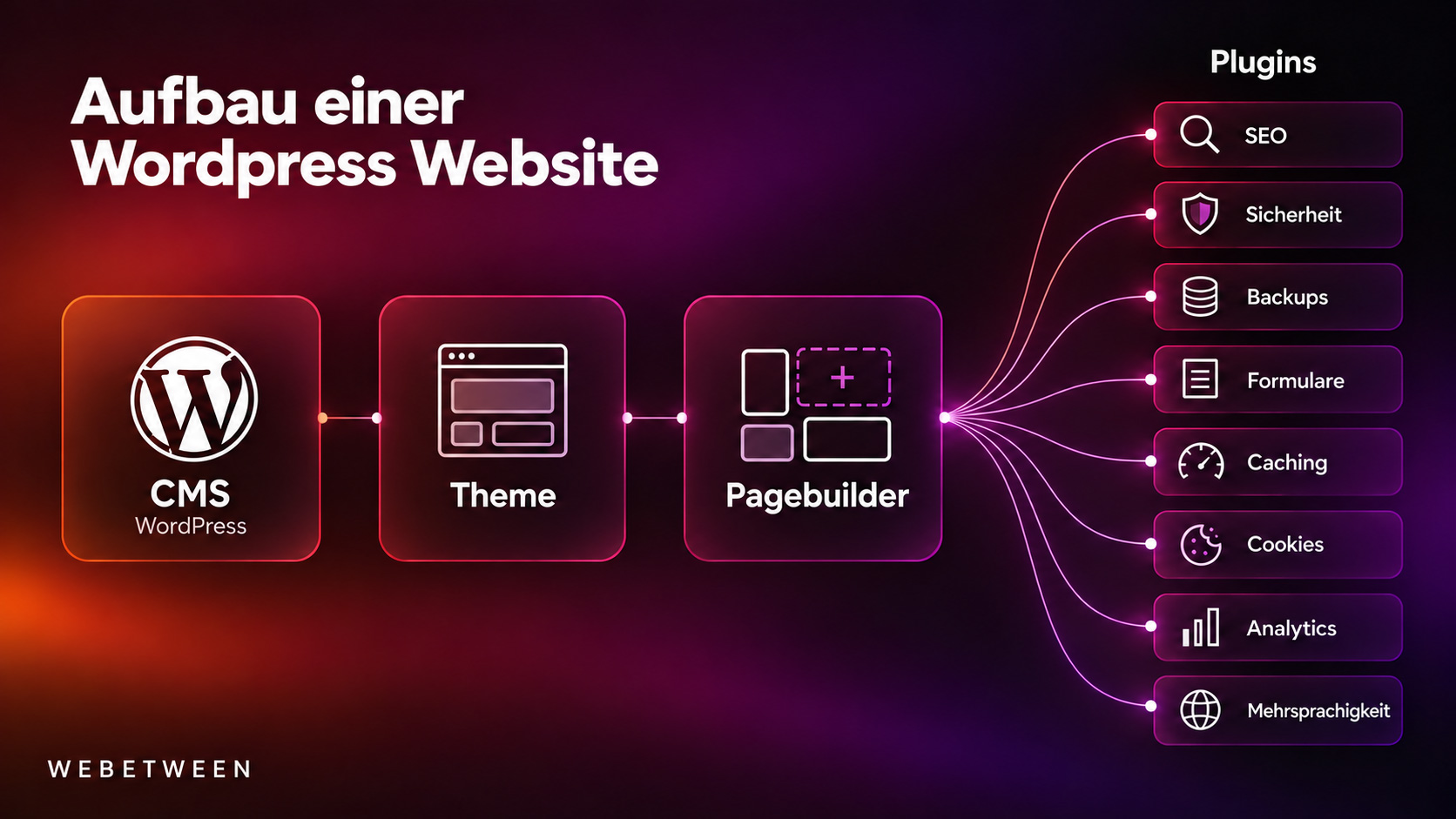
A WordPress corporate website typically consists of the core system, a theme, an additional page builder and multiple plugins from different vendors.
Plugins for SEO, backups, compliance, Google management, payments, caching and so on turn a WordPress website into a tech stack that is difficult to manage.
The WordPress core receives updates. Themes and plugins are updated too – independently of one another. On top of that come changes to the hosting environment and the PHP version.
A single update can alter a layout or break a feature. In the worst case, the website goes down. Such conflicts are very real: in WordPress development in 2026, a React update had to be temporarily rolled back after incompatibilities caused certain plugins to crash.
Running without updates is not an option; running with updates creates recurring monthly costs with no absolute guarantee that this patchwork will still work after the next update.
Technical work therefore does not end at launch. The assembled installation becomes an ongoing maintenance burden.
3. Staging reduces risk – and increases effort
On larger websites, updates are first applied to a test copy. This staging environment replicates the live website as closely as possible.
Then the checking begins: are the page layouts intact? Do the forms work? Are registrations being saved? Are integrated third-party services still running properly?
Only then are the updates pushed to the live website. Followed by another round of checks.
This process makes sense. It reduces the risk of downtime, though it does not guarantee zero errors. Differences between environments or incomplete testing can still cause problems.
Above all, the process takes time. Again and again.
4. €50 for maintenance – or for a system that lets you develop independently
If an agency charges just €50 a month for WordPress maintenance and updates, that comes to €600 a year, or €3,000 over five years.
All that buys you is the assurance that your existing website keeps working. A new page, an extra feature or a design change is not included. Those usually require a separate quote.
With your own Lovable Business account, by contrast, you get an AI-powered development system including website hosting. For our projects, we set up operations on EU-based servers.
You can edit content, add pages and build features yourself. Directly within your project and in your website's design. Changes you make yourself incur no follow-on agency fees.
Hosting for average traffic levels is covered within the included usage allowances.
Your ongoing budget therefore also funds the continued evolution of your website.
That represents very different value for money compared with merely keeping an existing installation alive.
5. A new feature should not be a procurement project
Take a simple example: your company wants to run events.
Visitors should be able to view dates, register and receive a confirmation. Your team needs an attendee list. And everything should match your brand design.
With a plugin-based setup, the work usually starts with a search.
Which plugin meets the requirements? Which features are included in which licence tier? Is an add-on needed? Does it work with the existing theme? How much effort will it take to adapt the design?
Once a choice is made, installation, configuration and testing follow. Product limitations have to be worked around through customisation or extra code.
With Lovable, we define the desired workflow and build it directly: event schedule, registration, confirmation and administration.
Task | Plugin-based WordPress implementation | WEBETWEEN with Lovable |
|---|---|---|
Starting point | Search for and test a suitable plugin | Define the required workflow and features |
Scope of features | Configure and extend existing capabilities | Build the exact features needed |
Design | Adapt the plugin interface to theme and brand | Build the interface directly in the website design |
Extensions | Review licence tiers and add-on modules | Add features directly within your own project |
Ongoing costs | Potential plugin and module licences | No separate plugin licence for the custom-built feature |
A custom-built feature still needs to be tested carefully. Data processing, access permissions and confirmations must work reliably. External services may incur additional costs.
Even so, you do not need another plugin subscription for every new task.
6. Extra tech can slow your website down
Plugins and page builders can introduce extra scripts, stylesheets and database queries. A feature-heavy product may load far more code than your website actually needs.
That can hurt loading times.
Then comes the optimisation work: setting up caching, stripping out unnecessary assets, inspecting scripts and tuning the hosting. WordPress itself outlines these measures in its performance documentation.
A fast WordPress website is possible. It just demands very careful implementation.
We focus on a purposeful build containing only the functions required and test actual performance. To solve a specific task, we do not have to integrate a bloated plugin product first.
7. The decisive shift lies in the architecture
Calling WordPress an 'outdated PHP framework' would be inaccurate. PHP continues to be actively developed. WordPress is a CMS built on PHP and MySQL or MariaDB, and React is also used within the system.
Our objection is aimed at the overhead created by piecing together and permanently reconciling multiple third-party products.
In the past, that approach was often more economical than custom development. AI-powered production changes that balance.
We build our Worksites with Lovable based on React and Tailwind CSS. Interface and functionality are created directly within the same project.
This allows us to start from your business's actual needs, rather than first assembling available plugins and