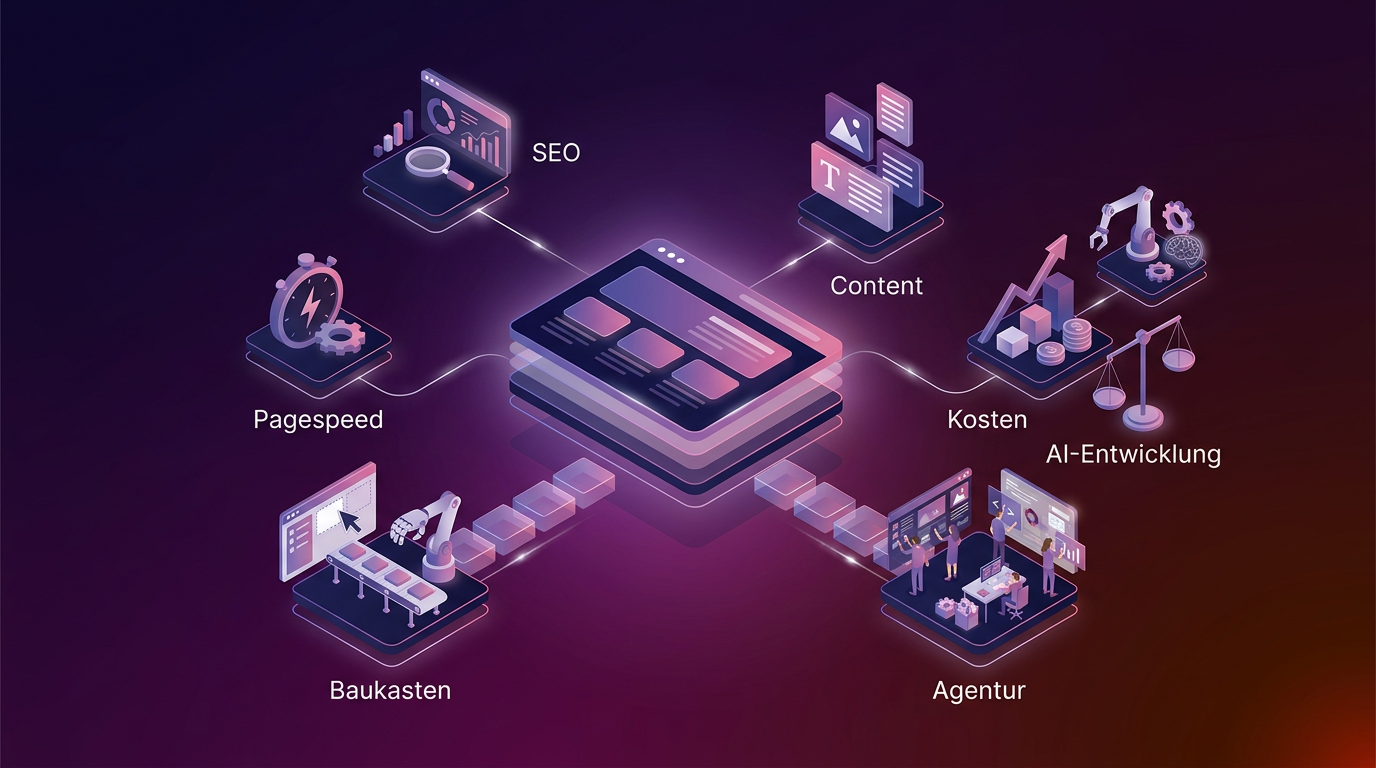
“How much does a website cost?” is one of the questions we are asked most often. The honest answer: it depends. Here, we explain which factors determine the price and how AI is currently reshaping the market.
The three traditional routes
Website builder: low monthly fees, but little individuality and limited functionality.
Freelancer: more affordable than an agency, but often reliant on a single person.
Traditional agency: high quality, but long lead times and large budgets.
What determines the price
Number of pages and languages
Bespoke design instead of a template
Copy, images and videos
Features such as forms, an online shop, calculators or a client portal
Integrations with CRM, accounting or calendar systems
Search engine optimisation and legal compliance
Don't forget the ongoing costs
With WordPress, regular updates, plugin licences, security audits and maintenance contracts are all part of the package. Many businesses significantly underestimate these costs over the years. Web agencies typically charge around €50 per month for an update service.
With our Lovable websites, our clients use the Business plan, which also costs €50 per month. However, for that price, you get a high-performance system and no longer need updates or ongoing agency maintenance.
What AI development changes
Platforms like Lovable significantly reduce development effort. Features that used to take weeks can now be built in days. For businesses, this means bespoke websites and even custom applications become affordable without compromising on design or quality.
Put simply: a website that used to cost €5,000 can now be built for half the budget.
Our recommendation
A successful website is the result of many factors working together. Concept, strategy, copy, design, imagery, page structure, SEO – a website can only succeed when all of these elements are aligned. You can recognise a successful website by two key metrics:
- Average time on site
- Conversion rate (page views in relation to customer enquiries)
Frequently asked questions about website costs and Lovable
Why can quotes for the same website differ by several thousand euros?
Often, they are not quoting for the same scope of work. One quote might only cover setting up a template, while another includes strategy, bespoke design, copywriting, image editing, data migration and integrations with your existing systems. Therefore, don't just compare the bottom line: ask for a detailed breakdown of which pages, content and features are included, how many feedback rounds are planned and who will look after the website after launch.
Which services should be explicitly included in a website quote?
The quote should specify the number of pages, mobile responsiveness, the creation or migration of content and the agreed features. Equally important are basic search engine optimisation, domain and hosting setup, and pre-launch testing. You should also clarify who provides the legal texts, whether an accessibility check is included and how you can edit content yourself later on. Additional requests should be governed by a transparent process for approving extra costs.
What ongoing costs arise after launch?
Alongside the initial build, you should factor in the domain, hosting or platform plan, and potentially email accounts. Depending on the website, paid third-party services may also be required, for example for appointment booking, newsletters, consent management or AI features. Content updates and future expansions also require time and budget. Before commissioning the project, ask for a separate breakdown of one-off costs, fixed monthly or annual fees, and usage-based charges.
Why can a website built with Lovable be more cost-effective than a traditionally coded website?
Lovable uses AI to assist with coding. This makes it faster to handle recurring development tasks and build initial working versions. However, the savings do not automatically apply to the entire project: strategy, copywriting, design, testing and coordination are still required. How much more affordable the website will be depends on the features you need and how complex the integrations with other systems are. For this reason, a flat-rate price saving cannot be guaranteed for every project.
Am I tied to the agency with a Lovable website?
Not necessarily. The decisive factor is who owns the Lovable project and what access credentials you receive upon handover. At WEBETWEEN, you get your own Lovable account for your website. Lovable also allows GitHub integration so that the source code is available outside the platform. Even so, switching providers later involves more than simply copying files: hosting, data, assets and connected services may need to be transferred and reconfigured separately. You should therefore clarify the handover terms at the quoting stage.
What drives up the price or extends the timeline the most?
Bespoke client portals, complex user permissions, multilingual content and integrations with accounting or other systems require more planning and testing than a standard corporate website. Missing copy and images, unclear responsibilities or additional requests during development can also increase the workload. A clearly defined scope and providing content early on make the budget and timeline much more reliable. AI speeds up development, but it replaces neither decision-making nor final quality assurance.