For many years, WordPress was a great system. We used it to build websites, bring businesses online and enable clients to manage their own content. At the time, that was a major step forward. However, a technology does not earn a place in the future simply because it succeeded in the past.
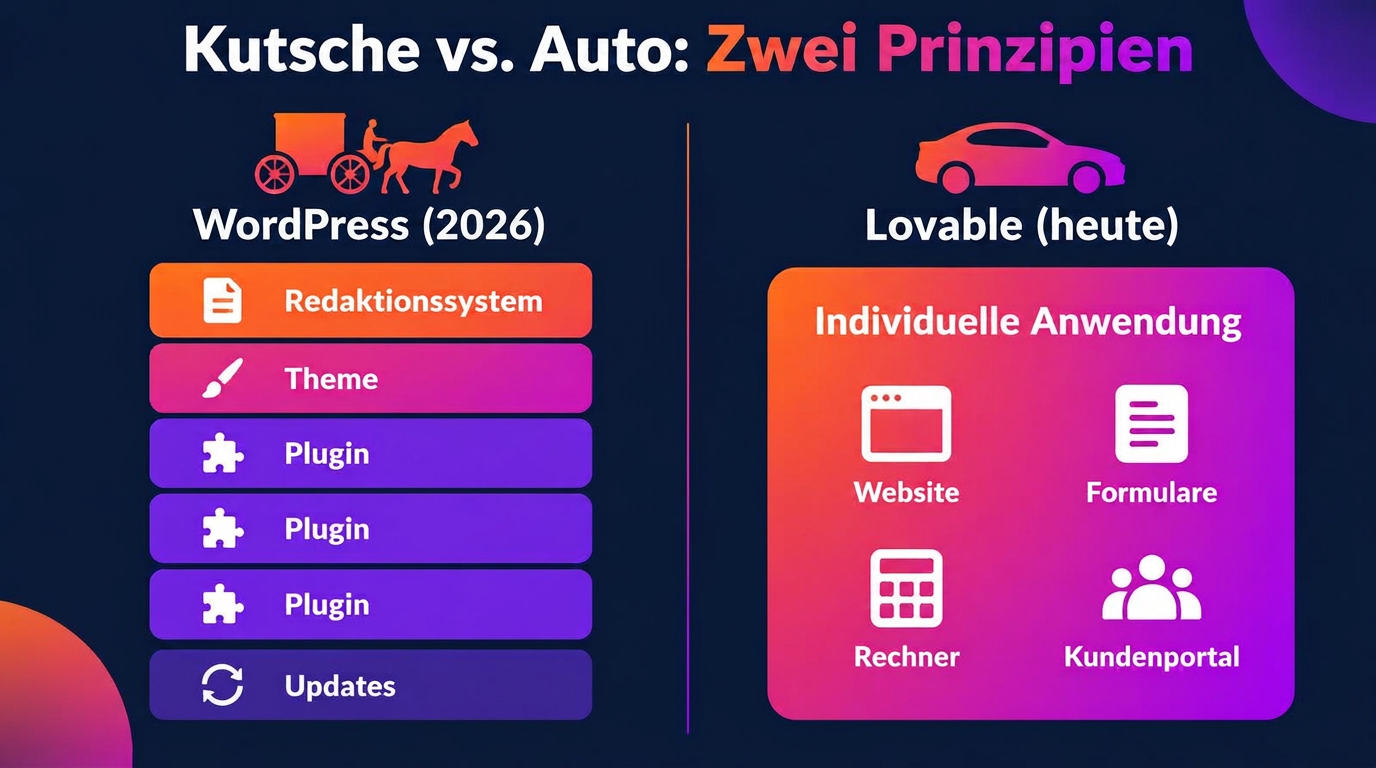
Today, we build with Lovable. Not because we are chasing the next AI trend, but because it has fundamentally changed how we look at websites. To us, comparing it with WordPress is like comparing a car with a horse-drawn carriage: both will get you from A to B. Even so, nobody would treat the combustion engine as merely an alternative to the horse. Progress is not a fresh coat of paint; it is a different underlying principle.
That is our stance at WEBETWEEN. To understand why, it is worth looking first at what made WordPress great – and why that very model is no longer the foundation we choose for new corporate websites today.
WordPress solved a genuine problem
When WordPress emerged from the blogging software b2/cafelog on 27 May 2003, publishing on the web was still a technical hurdle for most people. Matt Mullenweg and Mike Little worked on a system that allowed users to write and publish posts without having to code every single page by hand.
That blogging tool grew into a content management system. Content lived in a database, themes controlled the look and feel, and plugins added features. For businesses, the appeal was obvious: they could edit text themselves, swap images and publish articles. For agencies, it provided a shared technical foundation capable of handling a wide variety of projects.
Added to this were open-source software, freedom to choose any hosting provider and a huge ecosystem. Not every requirement had to be built from scratch; more often than not, an extension already existed. WordPress put professional-looking websites within reach for countless businesses in the first place. You do not have to downplay that achievement to choose a different path today.
The system continued to evolve in later years too. WordPress 5.0 introduced the Gutenberg block editor in December 2018. Editing became more visual and content could be assembled more flexibly. Yet the basic approach remained the same: an existing publishing system is expanded into the desired project using themes, plugins and custom tweaks. Note that we are referring here to the self-hosted software from WordPress.org, not the hosted service WordPress.com.
Sooner or later, the plugin model shapes the entire project
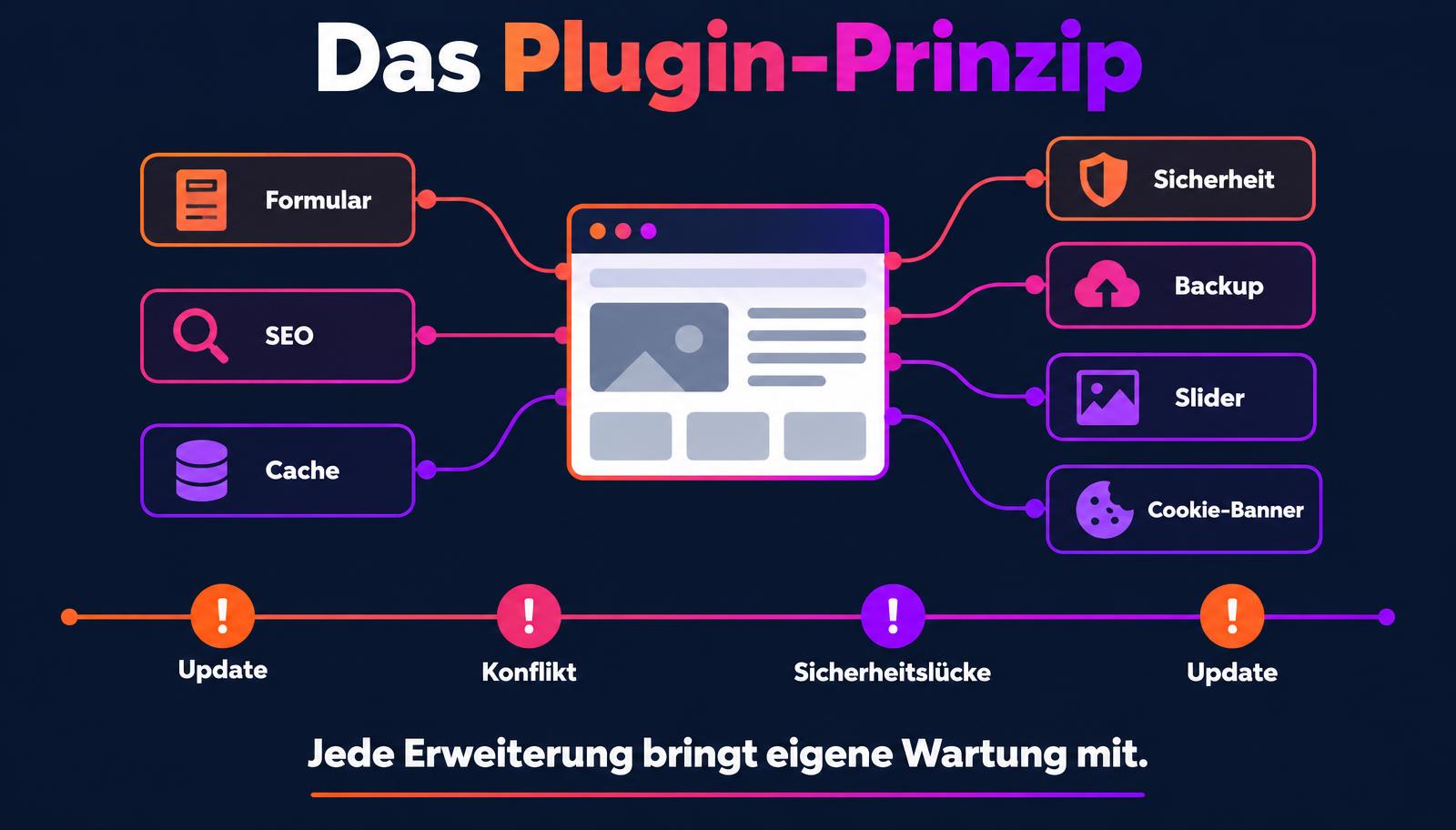
Need a contact form? There is a plugin for that. Search engine metadata? Another extension. Appointment booking, multilingual content, a client portal, an interface to your sales team? Yet more add-ons. For a single task, that can be convenient. As soon as those tasks need to work together, however, what looked like a straightforward website turns into a web of dependencies.
The limitation is not just about updates or licence fees. It starts much earlier: with the question of what a feature is even allowed to look like. Which fields does the plugin offer? Which workflows does it support? Can the layout be changed? Is the required API included in your pricing tier? Time and again, your desired business process ends up adapting to the constraints of an off-the-shelf component.
Of course, WordPress can be custom-coded. But if we have to build bespoke data structures, interfaces and workflows for a client anyway, a fair question arises: why are we building that application around a system originally designed to publish blog posts?
For us, that is the turning point. A modern corporate website should do more than simply describe what a company does. It should qualify enquiries, pass on information, prepare quotes, involve clients and take work off your team's plate. Those are not decorative extras. They are business processes.
Lovable changes the starting question
With WordPress, the search often begins with: “Which plugin can do this?” With Lovable, we start with: “What needs to happen for your business?” That shift sounds understated. In practice, it changes everything.
Lovable is an AI-powered development platform for websites and web applications. We define requirements, turn them into an interface and connect them with data and logic. The output is editable application code. Instead of configuring an existing plugin to fit as closely as possible, we build the workflow specifically around your business.
AI does not take over responsibility for the project. It speeds up implementation and allows us to flesh out variations and features much faster. We still have to decide which solution makes sense, whether data is processed properly and whether the result works in day-to-day operations. The difference is that we are working on the actual business task – rather than spending our time getting separate third-party plugins to play nicely together.
That is why we do not view Lovable as just another website builder alongside WordPress. To us, it marks the shift from assembling pre-made building blocks to engineering a dedicated digital working environment. That is the technological leap we mean.
An example: The enquiry is not the end, it is the beginning
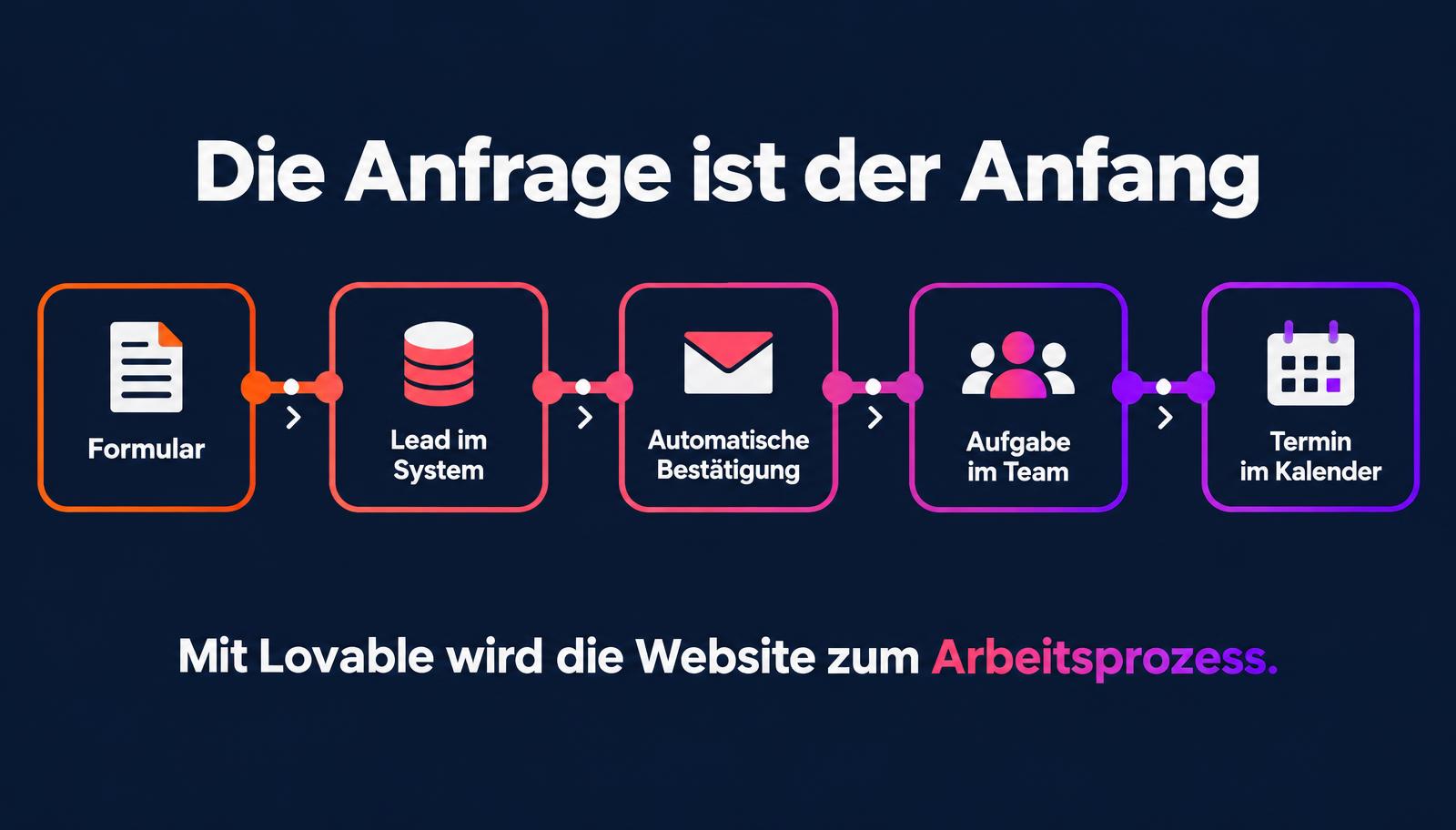
Picture a website where a prospective client submits a project enquiry. They select services, state a timeframe and add details about their company. A traditional form emails those details to an inbox. That is when the real internal work begins: copying information across, drafting follow-up questions, creating a record and preparing a proposal.
We do not want to merely dress up that disconnect. We want to eliminate it. The enquiry can be captured as a structured record, mandatory fields can adapt to the chosen project type, and handing the data over to project management can be part of the very same flow. Later on, a client portal can attach documents, feedback and sign-offs directly to that record.
Yes, a process like that can also be built in WordPress. The point is not that it is technically impossible. The point is that with Lovable, we can design it as a cohesive application from day one. Interface, data and handovers all serve the same task. We do not have to split the process across several off-the-shelf tools first.
The same thinking applies to calculators, booking flows, custom admin tools and client portals. On our page on web applications and digital tools, we show the kinds of tasks that go well beyond a standard corporate brochure site.
Managing your own content is not a WordPress monopoly
A common objection goes: “With WordPress, though, I can edit my blog myself.” True. That is precisely what made the system popular in the first place. It does not follow, however, that a modern website needs WordPress in order for you to do so.
In our Lovable projects, content management is planned right into the build. Creating posts, saving drafts, uploading images, maintaining SEO metadata and publishing content: all of these belong in a tailored admin console. They do not need to be tied to the interface of a one-size-fits-all publishing system.
Lovable does not automatically come with every feature of a mature WordPress editorial backend out of the box. Instead, we deliberately build the required management tools into the project. To us, that is not an argument against the new approach; it is a design task. Your team should be able to edit the exact content they are responsible for – without having to understand the underlying technical structure of the website.
Maintaining a collection of plugins is not a law of nature
Anyone running WordPress has to look after the interplay between core software, theme and plugins. That includes updates, backups, testing and checking for abandoned extensions. A WordPress installation can certainly be run securely and professionally, but those dependencies still have to be managed.
With a Lovable application, that specific WordPress stack disappears. No WordPress theme needs to stay compatible with a page builder and its add-on packs. Custom features do not have to fit around the release cycle of a third-party WordPress plugin. For us, that alone is a compelling reason to architect new projects differently.
That does not make software maintenance-free. A custom-built application still has dependencies and connected services. Permissions and data protection still have to be verified. A client portal is only ready for live use once a client can strictly access only their own data at the database level. That is professional software engineering – not a footnote made redundant by AI.
So our message is not: “With Lovable, you will never have to look after anything again.” It is this: we would rather focus our ongoing support on your application and its evolution than on nursing a WordPress setup patched together over the years.
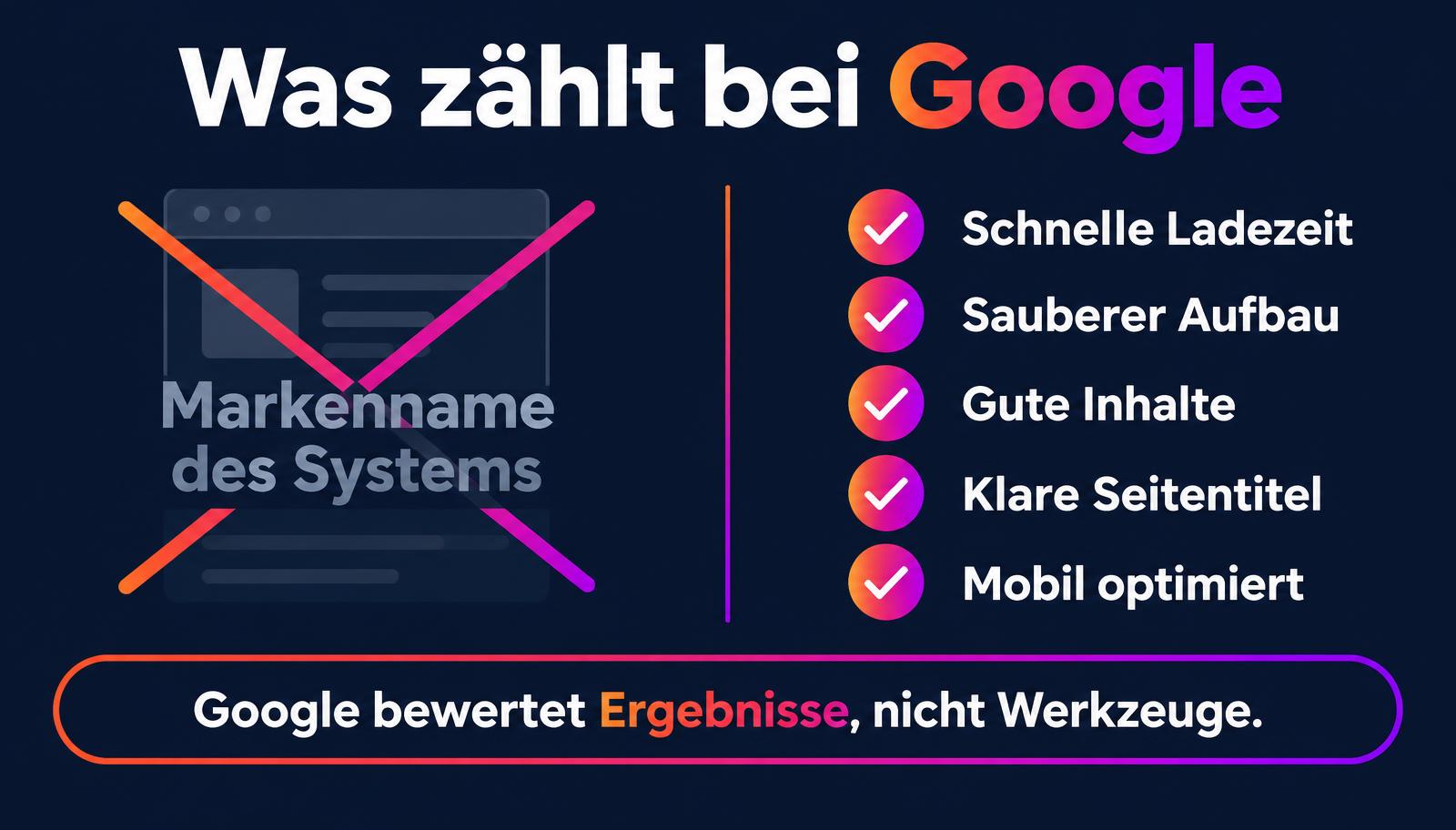
On Google, the brand name of your CMS does not win rankings
Our clear commitment to Lovable is not a promise of automatic top rankings on Google. Search engines do not reward our enthusiasm for a development platform. They need to be able to crawl content, understand context and find relevant answers.
Page titles, meta descriptions, internal linking, the sitemap and how content is rendered therefore have to be built properly into the project. The same applies to images, fonts and additional scripts that affect loading speeds. A first draft generated with AI is not automatically a finished, search-engine-optimised website.
For us, the advantage lies in building these requirements directly into the architecture. Search engine optimisation is not ticked off by installing a plugin. It is part of the structure, engineering and content. Likewise, a strong SEO article takes more than repeating a few keywords.
Commercial sense means asking: What can your website do tomorrow?
If you only compare the price of a finished homepage, you are comparing too little. What matters just as much is what future requirements will cost: a new calculator, an extra approval step, a link to your sales pipeline or a client portal.
With WordPress, hosting, premium plugins, maintenance and custom work can quickly add up. With Lovable, depending on the project, you need to factor in the platform, hosting operations, database and storage usage, and any external services. Those costs belong openly on the table. We do not claim a blanket cost saving for every single project.
Our commercial case for Lovable rests on development headroom: custom features can be developed with AI support without first having to shoehorn them into existing plugin logic. That means a website is not merely redesigned; it gains a foundation for the company's next set of challenges. We break down the individual cost factors in our article How much does a website cost in 2026?.
A relaunch must turn progress into practical value
Simply recreating an existing WordPress site visually would be a wasted opportunity. Before any relaunch, we review which content should stay, which workflows create unnecessary manual effort and which features will be needed going forward. Only then do we draw up the new concept.
Existing articles, images, links and key URLs have to be migrated cleanly. WordPress plugins are not simply installed in Lovable; the functions you actually need are purpose-built to replace them. Where URLs change, proper permanent redirects are put in place. After launch, we monitor indexing and search performance. Changing systems is never an automatic guarantee of unchanged rankings.
Ultimately, what also counts is whether everything works in daily operation: does the enquiry arrive? Is the data complete? Does the handover work? Can the editorial team edit posts? You do not just get a modern interface; you get a tested workflow. That is what we mean by a proper website relaunch.
Our view: WordPress was the right answer to an earlier question
WordPress made publishing on the web simpler. Lovable opens up a different path: building websites and applications around the actual tasks of a business. For our new projects, this is not a toss-up between two equally valid flavours. It is a deliberate decision to take the next evolutionary step.
That does not mean every live WordPress site needs to be switched off tomorrow. Moving systems requires a plan. However, continuing to run an existing installation and choosing the foundation for a brand-new project today are two very different decisions. For the second, we choose Lovable.
The horse-drawn carriage had its place in history. The car did not have to deny that legacy in order to transform transport. That is exactly how we see the difference here: we respect what WordPress made possible. Even so, we no longer want to build new corporate websites on its underlying principle.
As an official Lovable Partner, that is the standard we build to at WEBETWEEN: not the next collection of plugins, but the digital working environment that moves your business forward. Find out more on our page Lovable agency and development at WEBETWEEN.